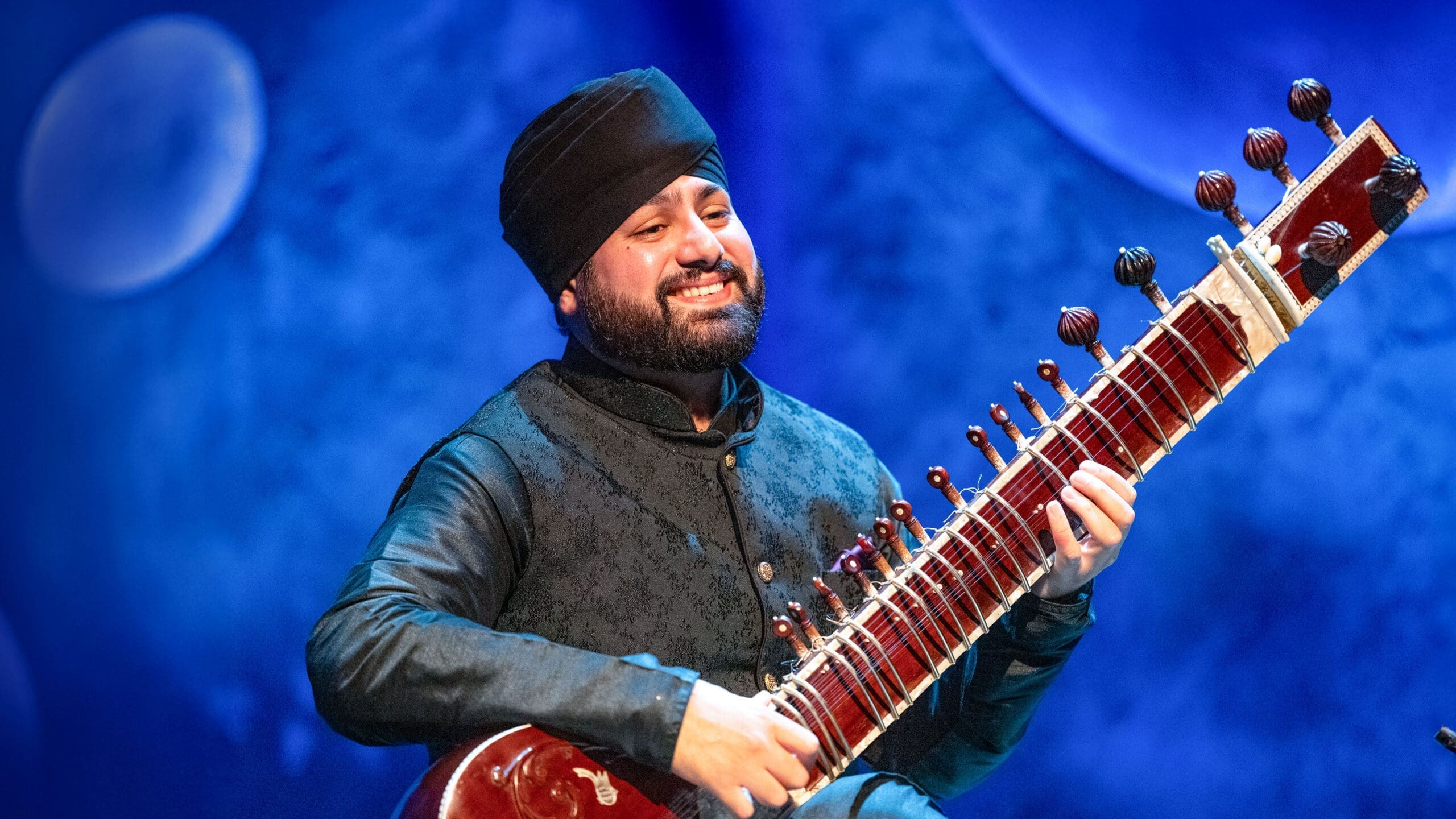
Sitar

The Sitar is one of the most iconic stringed instruments in Indian classical music, known for its resonant, meditative sound and intricate melodic capabilities. It features a long, hollow neck, a gourd-shaped resonator, and multiple strings, including sympathetic strings that enhance its rich tonal quality. Played with a wire plectrum (mizrab) on the index finger, the Sitar allows for expressive bends (meend) and complex rhythmic patterns, making it a versatile and deeply emotive instrument.
The Sitar’s origins trace back to the Persian Setar and evolved in India during the Mughal era, particularly in the 16th and 17th centuries. It gained global recognition in the 20th century, largely due to the legendary Pandit Ravi Shankar, who introduced it to Western audiences and collaborated with renowned musicians like George Harrison of The Beatles. Harrison, deeply influenced by Shankar, incorporated Sitar into popular Western music, most notably in songs like Norwegian Wood (This Bird Has Flown), sparking a cross-cultural musical revolution.
Many esteemed artists have carried forward the legacy of the Sitar, performing at prestigious festivals such as the Darbar Festival. Among them include Ustad Shahid Parvez, Ustad Irshad Khan, Roopa Panesar, Pandit Budhaditya Mukherjee, and Niladri Kumar, each bringing their unique style and innovation to the instrument. Their performances continue to showcase the depth and timelessness of the Sitar, ensuring its place in both classical and contemporary music landscapes.
Darbar believes in the power of Indian classical music to stir, thrill, and inspire. Explore our YouTube channel or subscribe to the Darbar Player to watch extended festival performances, talks, and documentaries in pristine HD and UHD quality.