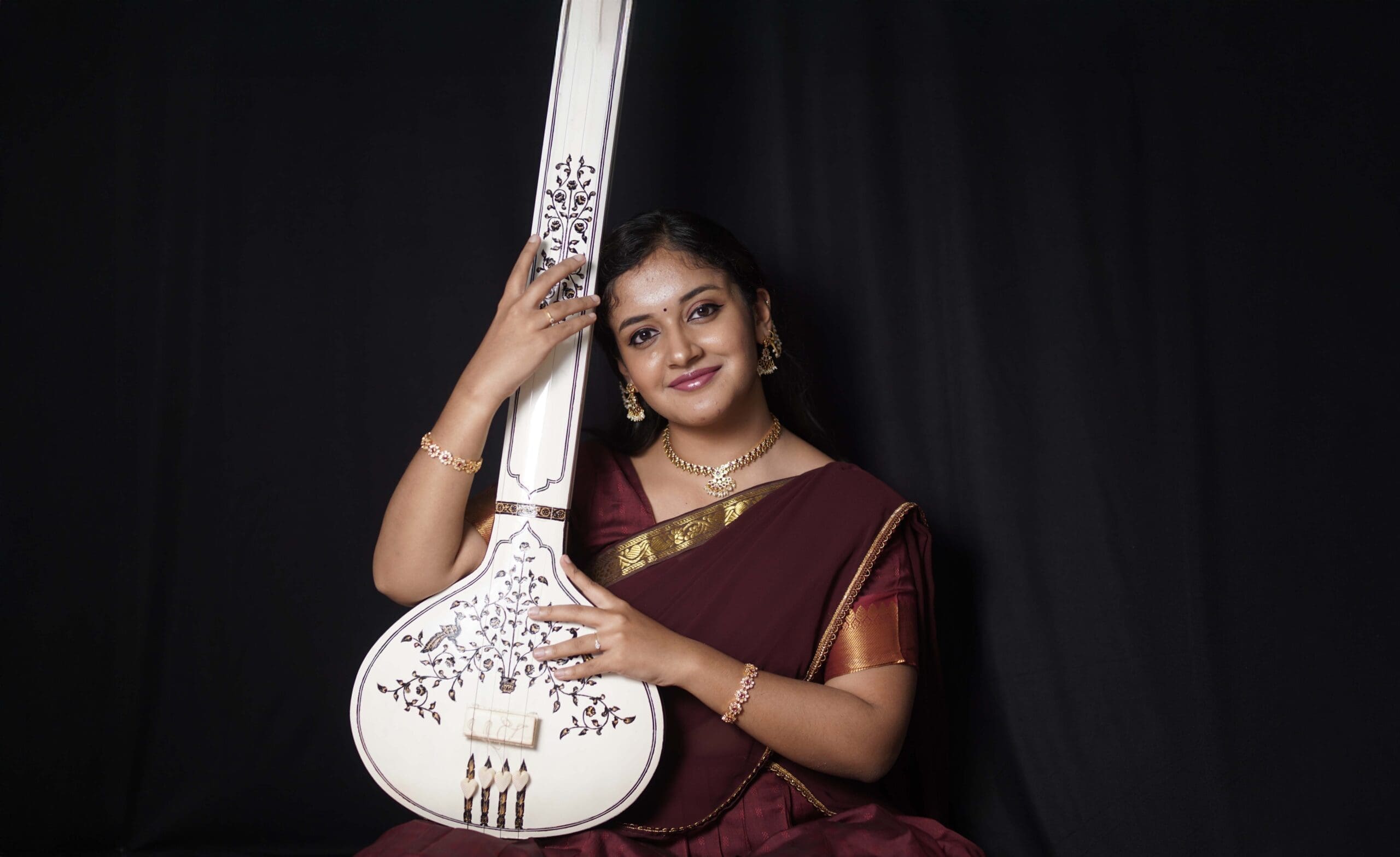
Sunanda Sharma

A torchbearer of the Banaras Gharana in India, Sunanda Sharma is a leading classical music vocalist specialising in khayal, tappa, thumri, dadra and chaiti. She also performs a wide range of semi-classical forms including kajri, and has woven folk and devotional music from Himachal Pradesh and Punjab into a classical framework, making her one of the most versatile and culturally rooted voices in Hindustani music today. Her singing has been described as a confluence of the refreshing breeze of the Himalayan peaks and the soft lapping waves of the Ganges in Banaras, a meeting of spirituality and romanticism that spreads its fragrance for all to enjoy.
Sunanda Sharma was born on 22nd October 1969 in Dah, a small village in the Kangra district of Himachal Pradesh, into a family with music at its heart. Her father, Pandit Sudarshan Sharma, was an Indian classical violinist and her earliest teacher, beginning her musical education when she was just five years old. After completing her schooling in Himachal Pradesh, she pursued higher education at Punjab University, Chandigarh, specialising in music and completing a master’s degree in Indian classical vocal music, graduating with a gold medal. The pivotal moment of her life, however, came not in a lecture hall but on a concert stage. A defining turn arrived when Girija Devi spotted her at the Hariballabh Sangeet Sammelan in Jalandhar and took her under her wing as part of the Guru-Shishya Parampara. Sunanda went on to live with her guru for nine years in Banaras and Kolkata, absorbing the nuances that would come to define her singing.
Her first solo album, “Dharohar”, was released in 2000 by Time Music, followed by “Swar Sanchay” in 2003 on Virgin Records and “Sur Ganga” in 2014 on Times Music. During her years of training she also received guidance from senior musicians such as Pandit Kishan Maharaj and Ustad Bismillah Khan, deepening her grounding in rhythm, phrasing and stylistic nuance. Her training with Girija Devi continued until the very last days of her great teacher and spiritual guide, a devotion that speaks volumes about the depth of that bond and the seriousness with which Sunanda has always approached her art.
Over the years Sunanda has nurtured her gayaki by weaving shastra and bhav paksh together to perfection, and through her musical versatility she has enriched the lives of aspiring artists as well as connoisseurs of the performing arts through performances and workshops across the globe. All the years at the side of the exacting Girija Devi ingrained in her a style inspired equally by the classical tradition of the Shastra and the semi-classical tradition characterised by bhav, or sentiment, and this has not prevented her from evolving musically. Reflecting on that formation, she has said that living with Girija Devi was not simply about learning music but about imbibing a way of life, and that her guru taught her that every note must carry both discipline and emotion. It is a philosophy that listeners can hear in every phrase she sings.