Omkar Dadarkar

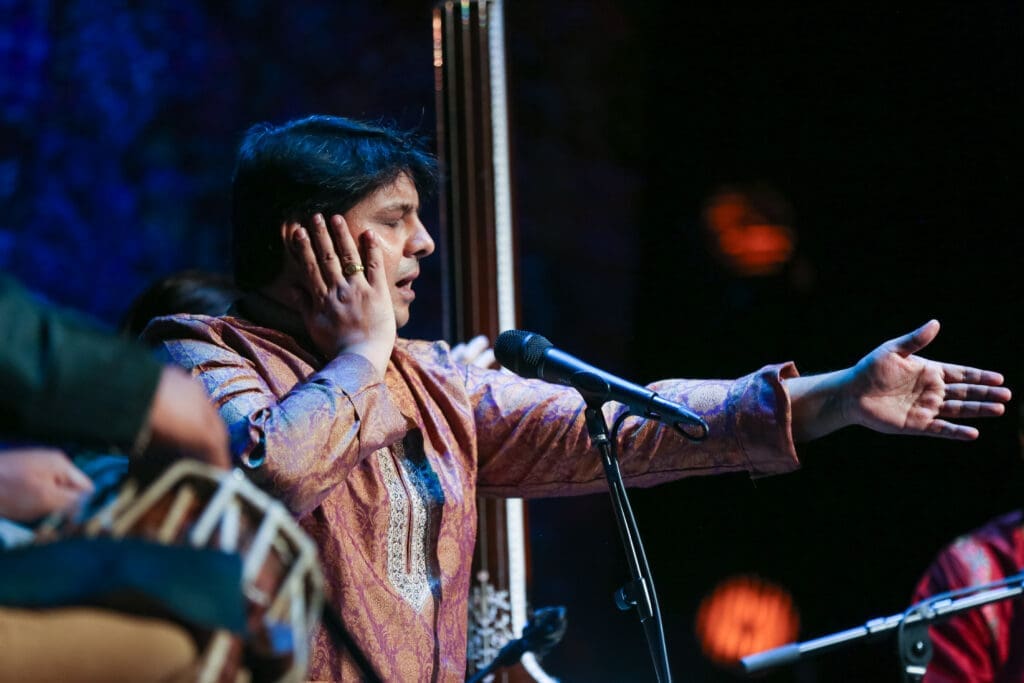
Omkar Dadarkar is an ‘edgy, comtemporary, and up-and-coming’ Hindustani classical vocalist, specialising in khayal, and is an exponent of the Gwalior Gharana tradition. Born in Mumbai in 1977, to Shrikant Dadarkar and Shubhada Dadarkar- not just his parents, but his first music teachers. Music was something he was born into; throughout his childhood, his house was always full of students who took lessons from his parents. His first exposures to music were not classical, however, but Natyasangeet; it was only through his Gurus that he picked up the alaap form and developed his renowned talent for the classical style.
“Patience is central to learning. The student must sit beside the guru, observe, watch, and absorb.”
Dadarkar’s first formal teachers were Shri Ram Deshpande and Smt Manik Verma, who he considers formative influences on his musical abilities. He then was fortunate enough to learn under the esteemed Shri Yashwanthbua Joshi, of the Gwalior Gharana, through the Guru Shishya Parampara scheme at the Dadar Matunga Cultural Centre, observing and learning from his Guru.
By 1999, he had been awarded a scholarship from the ITC Sangeet Research Academy, mentored by the acclaimed Hindustani vocalist Pandit Ulhas Kashalkar. He credits this experience as playing a significant contribution in his artistic development, allowing him to discover his musical style and sensibility, and strengthen the two to develop the phenomenal vocal power he is now renowned for. He also trained under Vidushi Girija Devi and Shru Shrinivas Khale, before finishing his Sangeet Alankar from Gandharva Mahavidyalaya.
Despite being so accomplished in Hindustani vocals, Dardarkar acknowledges that his initial training in Natyasangeet, and the deep-rooted tradition that comes with it, have had a remarkable influence on the mature and distinctive vocal style that makes him recognisable.
“Gharana and raag are not what attract people — musicality and enjoyment are.”
Dardarkar’s renowned talent has seen him gain both national and international recognition– he has performed at a variety of prestigious festivals across Dehli, Kolkata, Mumbai, Kanour, and Lucknow, as well as across the globe in Nepal, Canada, and of course the UK, at the 2018 Darbar Festival. His recognition does not stop at the venues he has graced- Dardarkar has received numerous awards for his talent, including the Ustad Bismillah Khan Yuva Puraskar Award for his contribution to Hindustani Vocal Music (2009/10), The Vidyasagar Award, and the Chaturanga Sangeet Shishyavrutti Award, of which he was the first ever recipient.
Dardarkar’s performance style is unique within its quiet confidence; a deep knowledge of not just raga structure and principles, but an understanding of the emotion involved, allows his deeply soulful performances to portray his artistic depth.
“Good music, listened to consistently, is how the path to learning is made.”
Dardarkar is a teacher himself, at ITC Sangeet Research Academy, the very school that awarded him his scholarship. His primary role is assisting with the Academy’s mission to uphold the Guru-Shishya tradition– a sacred, ancient Indian tradition that explores a profound bond between a mentor and student, with a significant focus on holistic learning, character building, and active guidance.
Within his teaching style, he replicates some of the methods that his own Gurus used for him. He encourages his students to listen and repeat- various styles, ghazals, and more- and replicate what it is they hear. This comes from a fundamental belief he holds that education cannot begin with a raag alone– ‘you must first attract a person to music before you can teach them music’, because the more you listen, the deeper you understand.
Dardarkar believes that patience is essential to learning. He uses the example “Gana, rasoi, ya pagdi — kabhi kabhi banti hai”, translated as ‘a song, a dish, a turban, comes together only sometimes’. He encourages constant practice and patience within his students education because it is only then that they will encounter that serendipitous moment where everything comes together and flows in the way that it should, just like how a turban can be tied a hundred times but its only because of that practice that the 101th time goes perfectly.
Darbar believes in the power of Indian classical music to stir, thrill, and inspire. Explore our YouTube channel or subscribe to the Darbar Player to watch extended festival performances, talks, and documentaries in pristine HD and UHD quality.